There are days when I wonder how I became a gardener in Zone 3. How can I love something so much that is so dependent on the weather when I live where it is winter forever, it seems? I have been busy reading about how to diversify my greens in the kitchen garden, advancements in urban gardening and now, most importantly, how to protect my early flowers from frost. I have been doing all of this reading in preparation for the coming garden season and in anticipation of spring. Little did I know that winter is just arriving! We have had the most wonderful, mild winter in Saskatchewan this year. Last week the snow finally arrived and has not stopped since. The temperature is beautiful though so we have been in a cycle of melt, freeze, melt, freeze, melt, freeze.... which is great for ice photos of the trees but not so great for the spring flowers. I think they are likely getting confused. I hope I don't lose too many of them. The freeze/thaw cycle here can wipe out whole gardens if the temperature drops at just the right time. I am ready though. All of my sheets are steps away from the garden if I need them after the first buds pop out. This is a year when the Boy Scout motto is well advised - be prepared!
Showing posts with label garden schedule. Show all posts
Sunday, March 4, 2012
Wednesday, February 22, 2012
Always Learning
I am always learning about gardening. I consider myself an expert flower gardener, having been doing that for over 20 years now. I still find out new things about old plants that surprise me. I think that is part of what I love about gardening. I am always learning.
Vegetable gardening is relatively new to me. This year will only be my third year at trying them. I have grown previous crops in my flower garden, between the flowers and also in containers. This will be the first year for me to have a proper kitchen garden and the crops I am planning are much more than I have tried before. It is a lofty goal for a flower gardener.
Organic Gardening has a wonderful article on succession planting which is a concept I plan to try next year. This year, my kitchen garden is new and I am not yet certain where or what size it will be so making a plan for succession planting feels beyond what I can accomplish quickly. But there was a fantastic tip in the article that I plan to use:
Vegetable gardening is relatively new to me. This year will only be my third year at trying them. I have grown previous crops in my flower garden, between the flowers and also in containers. This will be the first year for me to have a proper kitchen garden and the crops I am planning are much more than I have tried before. It is a lofty goal for a flower gardener.
Organic Gardening has a wonderful article on succession planting which is a concept I plan to try next year. This year, my kitchen garden is new and I am not yet certain where or what size it will be so making a plan for succession planting feels beyond what I can accomplish quickly. But there was a fantastic tip in the article that I plan to use:
- Vegetables that belong to the same plant family (such as cabbage, mustard, and kale) share pests and diseases. It's wise to keep in mind what family a vegetable belongs to and avoid planting one member, say tomatoes, in the same spot where a cousin—peppers, eggplants, potatoes, or tomatillos—grew in the previous 3 years.
Thursday, February 9, 2012
Starting Seeds This Season?
I keep going back and forth on whether I am going to start seeds inside this year or not. I would rather not but we have such a short growing season, the list of what I can't grow is huge. I am still undecided but that can't last much longer - spring is coming!
If you are planning on starting seeds, there is a good article that contains a simple seed starting plan at Organic Gardening. It also has how to instructions for making your own seed starting mix and newspaper seedling pots.
Tuesday, December 6, 2011
And it goes on...
Everyday is a new wonder. I have a new latest plant date! December 6. Today I planted tulips. It was beautiful weather with the temperature at +5. The tulips I planted are all mixed bulbs. The mix is made up of every tulip I had out in the garden this year and last. It should be interesting to see how they come up because when you are just looking at bulbs, there is no way to tell the flower colour. I am looking forward to what these patches might look like. There are a lot of them too. I planted about 100 of them today and if the weather holds through tomorrow, about that same amount will go in again. Then all my tulips will be in ground.Tuesday, November 29, 2011
Still Planting...
I planted again today! I stopped by Judy's for coffee and when she heard that I had been able to dig the other day, she handed me a container of 'White Lion' Daffodils I had given her. So out into her yard I went. She has more snow than I do here but underneath it, the ground was not frozen. I was easily able to dig a hole and drop them in. New latest planting date for me and I think if the weather holds, my tulips may go in yet.
Sunday, November 27, 2011
From the Realm of the Fantastical
The ground is not frozen and yes, that is a hole in it! Today I was working in the garden. It is definitely the latest date I have ever dug in the garden. We have snow left but not a lot of it and the weather has been beautiful. Just for fun, I kicked the dirt around a bit when I took the dogs out today. Sure enough, it was not frozen so I grabbed a shovel and tested it some more. Before I knew it, a hole was dug in front of the weeping caragana in the sideyard and I was popping in the bag of lily-of-the-valley root from Judy's backyard. It has just a good a shot at making it there as it does in the house and I always advocate planting in fall vs. spring if you can. In my zone, this gives things a much earlier start and with a short season, the earlier the start, the better. I am keeping my fingers crossed for them. Spring will tell.
Tuesday, November 8, 2011
And then there was snow...
When I worked in operations, nothing annoyed me more than Christmas. Every year, year after year after year, we would experience delayed shipments, no staff and general confusion. My thoughts were always... Christmas comes every year at the same time... how does it take so many people by surprise? Well, welcome to my garden where the same issue comes back to haunt me. Every year, year after year after year, Mother Nature decides when my gardening season is going to end. She always decides this around the same time. I couldn't set my clock by it but fall is always followed by winter. This year has been better than most for my garden timing. I only have 4 shrubs and a pile of bulbs that did not get into the ground. Now I am left with the decision to put it all in the shop for the long winter or dig in the snow to drop them in. I haven't decided yet. It will depend on the temperatures over the next few days. Regardless of what I do, winter has arrived in my zone 3 garden. Nothing to do but play with garden maps, read garden books and wait for spring. The season that never takes me by surprise. I am usually watching for the ground to thaw for weeks before it actually happens.
Saturday, October 15, 2011
A Note on Maps
My garden maps have been an on-going problem. At the start, I made one dimensional bed outlines full of circles representing the plants as seen from a bird's eye view. I use my maps primarily in the spring when I am looking for specific plants or looking at something poking up through the soil that I cannot identify. Maps helps then. I found it was impossible for me to figure out exactly where something specific was with no markers or landmarks on the maps that showed me the plants in relation to other things like large rocks, bird baths or bridges. I also found that because I do not view the garden from a 'bird's eye', the maps did not work for me. I do not use maps to visualize my blooming garden. For that, I use my imagination, area sketches, cut out photographs and transparencies layered over the bed outlines. The transparencies work particularly well for placing shrubs or overlaying bulb plantings which for me, mostly means tulips. Over time, I have developed the map style above which works much better for me. I mark in permanent 'landmarks' in the bed and do only one bed per map. Since I do not use the maps to visualize or develop the garden views, a single bed is much more effective on a map for my purposes, making locating plants in the spring easier. Above is my boardwalk garden entry bed on the lowest level of that garden. It is complete to the point it will be complete in the fall. My maps are a winter project. I get the basics down and tidy them up over the winter. For example, I know what hosta variety is planted above as well as the name of the purple viola, but not off the top of my head. In the winter, I will look them up and complete the labeling. Tulips do not need an overlay on this map because there are very few perennials planted here. This bed is one of two beds in this garden that I fill with annuals in the spring. You can see how the overlay would be helpful if this bed was also full of perennials. Cleaning up my garden maps is one of my favourite winter projects. It is particularly helpful on a long, cold, windy winter day by reminding me that the snow will eventually melt. Then there is the added bonus of the extra time it buys me in the fall. I can spend endless hours tidying up my maps - time I never have in my fall garden schedule. I suppose I should get to planting those tulips now. The weather is turning cold here and Jack Frost is in danger of catching me unprepared. Unprepared is not a good winter strategy in Saskatchewan.
Saturday, August 13, 2011
Patience Rewarded
Isn't she pretty? Three years ago, I planted 6 bareroot poppy. Three were 'Royal Chocolate Distinction' and three were 'Miss. Piggy'. They were planted together and I am sure would have looked awesome blooming side by side. It was the last year that I planted bareroot plants because even as I dug and buried, I had very little hope I would see plants. They were really such pathetic little things, as were the coneflower roots that I planted the same year. In all, I planted 15 bareroot plants that year and I have yet to see any of them with this single exception. She popped up out of nowhere this year and I immediately cleared everything away from around her in an effort to save her. Although I would say she was well worth the wait, I am still not planting anything bareroot. It was a long wait. My next thought, of course, is that I hope her seed is not sterile...look for the update next season.
Thursday, November 11, 2010
November Blooms
Mid-November and we still have lots of blooms (or re-blooms) in the garden: this masterwort, honeysuckle, daisies, snap dragons, roses, dahlias, gaura, bugleweed, heather, daylilies, lobelia, lamium...
Tags:
fall,
garden schedule,
masterwort,
perennials,
weather
Sunday, November 7, 2010
Soon to be Mulch
We make a lot of use out of all the leaves. We shred lots and use as mulch in the garden. Piles of them get composted every year and eventually find their way into the garden. After 3 days of constant rain, we're going to have to wait for them to dry out. The other nice thing is that, with so many trees around, the garden gets an extra layer of mulch for the winter without any extra effort.
Tags:
fall,
fall garden chores,
garden schedule,
mulch,
weather
Friday, October 22, 2010
Tulip Deadline Zone 3
It is time to finish planting and moving tulips in zone 3. According to Environment Canada, we have three more days of good weather and then a few of bad. Once the bad hits in Saskatchewan, all bets are off and there are no guarantees. Last Fall, I added so many new tulips that this Fall, I am finding myself content with moving what I have here already and saving some of the old that are struggling in very tight spaces. The fact that Linda and I were discussing tulips the other day, which made me pull out my trusty notebook, to realize that so many of my new ones did not perform well this year, has made me a little tulip weary. I was planning on just moving my 'Angelique', 'Bastogne' and crowded 'White Dream'. I think now that I will move all of the tulips that did not perform well this year and see if I can get them to give me a better display next year. I am hopeful that even with the increase in number, I can finish in one day so that is now my agenda for tomorrow. I am starting my race against time... and snow!
Wednesday, October 20, 2010
Fall Buds
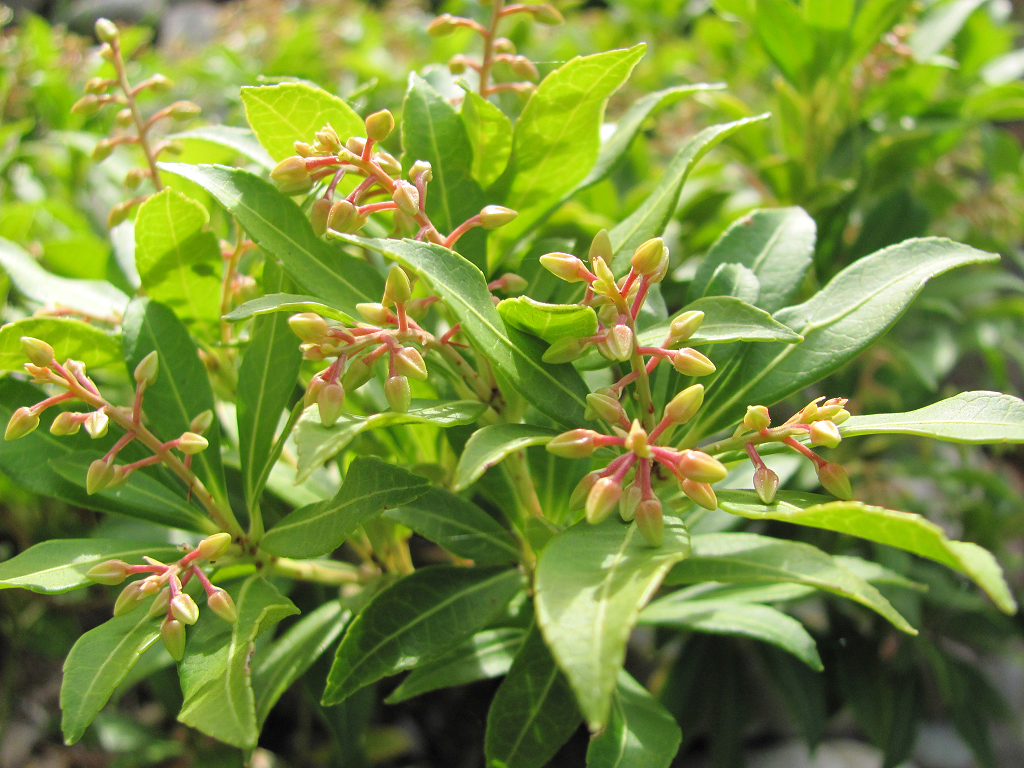
It always amazes me that some plants grow their buds in the fall. It seems a little backward. Those little buds have to survive the long cold winter! Above is my Japanese pieris 'Purity'. Azaleas, my miniature rhodo and a few heathers are also full of buds. And then there's the oddities - like my 'America' Asiatic lilies that are all developing buds in October.
Tags:
fall,
garden schedule,
perennials,
pieris
Tuesday, October 5, 2010
Gladiolus - Lift in Fall
This is the first time I have lifted glads. This is what came out of the ground. According to what I am reading, I am supposed to break off the old corm at the bottom and store the new corm that sits on top of it. Somehow breaking off the root part seems so wrong. I suppose I buy glads without root so it does makes sense. Still feels wrong though. I think because I spend so much time trying to save and preserve plant root in hopes a plant will come back from it, I am reluctant to break root off and just toss it away. I guess I'll see how I feel once they are dry. Maybe it will fall off on its' own by then and spare me the guilt.
Tuesday, September 28, 2010
Time to Winter Mulch
In my zone 3 garden, it is time to think about winter mulch. I have several zone 4 Lily and now a few zone 4 Coral Bells that came from Linda's Garden. The theory behind winter mulch is that you put it on in Fall and take it off in Spring. I have not been historically good at the taking it off in Spring part of that equation. Mostly because I have a huge list of other chores in Spring that bump removing mulch so far down the list, it never happens. Although my garden has never suffered any visible effects of this particular neglect, I often wonder when the Lily stalks will start to have trouble getting through all that year after year mulch and Coral Bells stalks are not as strong as Lily. So this year, I am trying a new strategy with the Coral Bells. I am going to drop full bags of mulch on top of them as late as possible. They will be easy to pick up first thing in Spring and I can use the mulch in the garden where I need it next season. Since the Coral Bells also reside in a raised bed, this method should ensure the mulch does not overflow the bed. I have no clue if it is going to work because I came up with the idea after reading an article about planting annuals in bagged soil that stays in the bag. I can think of no reason that it shouldn't work though and if it does, I have made that Spring chore so easy and fast it will never be bumped to the bottom of the list again!
Sunday, September 26, 2010
Fall Seed Sowing
Hardy perennials and self-seeding annuals in your zone can be sown in the Fall. The advantage to Fall sowing is that your plants will get a head start in the Spring, bringing you an earlier display the following season.
With hardy perennials, they should just be dropped where you want them. The key is to wait until it is cool enough that they will not start germinating in the Fall or to sow them early enough that they can germinate and set root in this season. You do not want them starting germination but not able to set root before your winter. Seeds require specific light, water and warmth conditions before they will germinate so once your weather turns cool, you are usually safe for Fall sowing. Just remember many perennials will not bloom their first season.
With self-seeding annuals, you know the seeds will survive the winter. In this case, you can get a jump on Spring by sprinkling the seed in your garden in the Fall, the same way the plant would release the seed on its' own. You can let the plants do this for themselves if you want to repeat them in the same space or you can harvest the seed and drop it in any new garden space you would like the plants to grow next season. The seeds will germinate in your garden often earlier than you would consider sowing them in the Spring, bringing you flowers earlier in the season. Another advantage of this schedule is that you need not worry about Spring weather. This year, for example, my garden was too wet to walk in long after seeds should have been sown.
If you collect seed, garden experiments are free of charge and are the best way for you to discover what works in your season, your soil, your garden. In my zone 3 garden of largely clay soil, I have had success with Fall sowing of Marigold, Hollyhock, Delphinium, Viola, Pincushion Flower and Forget-Me-Not. This year I am trying Hollyhock again because I want a new patch in a new space and I am leaving the Marigolds and Calendula to drop their own seed in hope they will appear in the same space next year.
With hardy perennials, they should just be dropped where you want them. The key is to wait until it is cool enough that they will not start germinating in the Fall or to sow them early enough that they can germinate and set root in this season. You do not want them starting germination but not able to set root before your winter. Seeds require specific light, water and warmth conditions before they will germinate so once your weather turns cool, you are usually safe for Fall sowing. Just remember many perennials will not bloom their first season.
With self-seeding annuals, you know the seeds will survive the winter. In this case, you can get a jump on Spring by sprinkling the seed in your garden in the Fall, the same way the plant would release the seed on its' own. You can let the plants do this for themselves if you want to repeat them in the same space or you can harvest the seed and drop it in any new garden space you would like the plants to grow next season. The seeds will germinate in your garden often earlier than you would consider sowing them in the Spring, bringing you flowers earlier in the season. Another advantage of this schedule is that you need not worry about Spring weather. This year, for example, my garden was too wet to walk in long after seeds should have been sown.
If you collect seed, garden experiments are free of charge and are the best way for you to discover what works in your season, your soil, your garden. In my zone 3 garden of largely clay soil, I have had success with Fall sowing of Marigold, Hollyhock, Delphinium, Viola, Pincushion Flower and Forget-Me-Not. This year I am trying Hollyhock again because I want a new patch in a new space and I am leaving the Marigolds and Calendula to drop their own seed in hope they will appear in the same space next year.
Wednesday, September 15, 2010
Direct Seed Sowing: Fall or Spring?
I only sow seeds that can be direct seeded in the garden, using the method known in the seed sowing world as in situ, or, right where I want them to grow. I also try to direct seed as early as possible. Any seeds that can be sown in the Fall, I will drop within the next few weeks. Any seeds that could not survive my winter will be dropped in the Spring. I find that seeds are enormously rewarding in my garden because it is very little work for a big pay off with blooms right through until frost. Although there are some seeds that require specific or complicated care to sow, the vast majority of seeds are easy, requiring only that you drop them at the right time. The easiest way to know when to drop seeds is by watching which plants will self-seed in your garden. If, like Hollyhock in my garden, a plant will self-seed in your garden, you know the seeds will survive your winter and you can drop them in Fall. The advantage of dropping what you can in Fall is that seeds will generally germinate earlier in the garden than you would even consider dropping them in the Spring. In my garden, Fall dropped seed often starts to appear before it is dry enough for me to consider walking in the garden. If I did not drop them in Fall, their flower display would be much later in the season for me. If the plant does not self-seed in your garden, chances are its' seed is not surviving the winter and it needs Spring sowing. If you don't know if a plant will self-seed in your garden, sow the first seed in Spring. The following Fall, collect some seed and bring it indoors to store in a cool, dry, dark place while also allowing some of the seedheads to release their seed in your garden. You can help that process along by taking the dry seedheads off before the plant releases the seed and spreading the seed manually in your garden. The list is probably much longer but the plants that self-seed in my zone 3 garden today include: Marigold, Delphinium, Hollyhock, Bachelor's Buttons, Viola, Calendula, Daisy, Columbine, Yarrow, Goutweed, Speedwell, Summer Phlox and Knautia. Now the obligatory disclaimer: gone are the days when all seeds produced a predictable plant. Some seeds of hybrid plants will not grow true to seed, meaning that the plant you get will not be the plant you took the seed from. It is more likely to be one or other of the parent plants which are the plants that were used to produce the new variety. Still other plants are bred to be sterile and if they produce seed, the seed will not produce a new plant. Don't ask me! I think it makes no sense to have a plant that doesn't reproduce itself and makes even less sense to have a seed that produces nothing. I tend to stay away from those plants and stick to heirlooom, old-fashioned or country plants that tend to act like one expects a plant to act. If you collect seed though, experiments cost nothing but a bit of space in your garden. Try it. You will find it can be well worth the effort.
Sunday, August 29, 2010
Our Dahlia Story
Linda and I have had Dahlia in our gardens for awhile but this year, we stepped it up a notch. It started with my bright idea mid-winter to order 49 varieties of Dahlia, three tubers each. All I can say is that winters here are a long time to go without gardening and some decisions are made under the influence of cabin fever! It really got interesting in Spring when Saskatchewan had its' first rainy season that seemed to never stop.
For reasons I will detail in a future post, I cannot dig my soil when it is wet. The result is concrete chunks that nothing could grow in. Amending my soil when wet is equally disasterous. Coupled with my short season, this meant that most of my new dahlia were going to wither without ever being given a chance. It would have been tragic if Linda and Judy had not jumped in to save the day.
I planted Dahlia on every day I could until it was clear it was getting too late in my season. About this time, I was invited to visit Linda and accepted. I then took one of each unplanted variety to my friend Judy's in the city. She planted them in her garden while I was gone. I took one of each variety and popped them into pots in my garden and left them in my husband's care. I took the last of each variety in my suitcase to Linda. She and Kelly planted them in her garden while I was visiting. My hope is that at least one of each variety will survive in one of these places and we will all exchange next Fall or the following Spring, eventually leaving each of us with all varieties. Or, at least, all the varieties we each decide we want to grow.
It is late for Dahlia to be starting but in our gardens, this year, they are. A few are blooming, many are budding up and all three of us are hopeful for late frost. The result is that Dahlia seem to be all we talk about lately. New flower forms, sizes and colours have generated a fresh excitement for my garden in the last few weeks.
I will start with Dahlia 'Hot Lips' which is the collarette above. It opens deep, deep red and fades to an orange-red that is not as dark but is twice as bright. Height was listed as 3.5' but it is much closer to 4' in my garden. Flowers seem to range between 3.5" and 4". I want to say it is one of my favourites but I am already in danger of making them all favourites.
One of the things I have noticed about the few Dahlia that have opened so far is that they do change colour very quickly after opening. Each individual flower lasts a long time but they do not seem to open true to the mature flower colour. Of course, what I notice in this odd weather year may not be the same as what I notice next year. This is what gardening is all about for me. The discovery. I am looking forward to more and more Dahlia discoveries. Since they will not all bloom for me this year before frost, that excitement will carry over into next season. I am already anticipating it!
Friday, August 27, 2010
Time to Divide
I'm pretty sure the rule is:
- early blooming - divide in fall
- late blooming - divide in spring
Tags:
garden schedule,
perennials,
planning,
tips
Daylily Division
This is the year I discovered the daylily. I have always known about daylily having several 'Stella D'Oro' that I was not impressed with and had seen many, many varieties that I felt were equally unimpressive. It started with Linda's 'Frans Hals' and progressed to Alison's Red and my unknown above. Somehow, these bright colours from the Fall palette have converted me to a daylily lover. This week, I came upon an article in a recent issue of Canadian Gardening on the daylily and learned two very interesting facts. One of which turned out to be critical for the survival of my daylily since my new found fondness has got me determined to divide them this year so they will spread throughout the Sun Gardens next year.
Fact one is that some daylily are nocturnal, opening in late afternoon and remaining open until the next morning. This would be more interesting were I planning an evening wedding in my garden but is still a fun fact I am glad they included. Unfortunately, there were no nocturnal varieties listed.
Fact two is much more helpful for my garden because I tend to divide when I find time rather than following the old adage that I can never remember about spring blooming and fall blooming division times. According to the grower (who, from the photographs, clearly knows what he is doing with daylily), you have to divide Daylily at least one month prior to the first hard frost in your location. This is so they can have enough time to build up their sugars before they go into full dormancy. This is a critical fact in my garden because frost comes early and I work right up to it.
I am so glad I found this article now. For me, this means I need to start daylily dividing today. The fact that Canadian Gardening saved all the daylily I have out in my garden, more than justifies my regular over-spending at the magazine stand :)
Subscribe to:
Posts (Atom)